
Systems Thinking & The Internet of Things

Everything and everyone connected everywhere. The Internet of Everything becomes a ginormous pulsating organism? social structure? ecosystem? Whatever its nomenclature, it will be a system of non-linearity increasingly obvious in a world where most humans prefer their explanations in simpler linear predictability.

Some posit that this ubiquitous interconnectedness will be evident in 10 years. In traditional education terms, that’s equal to 4 years at college, 4 years of high school and two years surviving junior high. So we can think of those 6th-graders, 12 years and straining to reach the anticipated glories of adulthood. By the time that they finish with another decade of formal education, we can easily imagine them as facile participants in this digitally-connected world. Guessing the number and power of connected computers that will be part of their lives is about as difficult as determining the number of gum balls in a pickle jar. The iPhone5 has the processing power of the Apollo Guidance Computer. Your car already has upwards of 50 computers and millions of lines of code. My refrigerator has a usb port.

How can we ensure that our imaginary 6th-grader will reach 2025 with the abilities of a system thinker? How often will simulations and modeling be part of that decade of education? When will visualization and other transformations of data become as requisite as writing? When will our student learn to code and explore the properties of feedback loops?

Preparing humans for successfully living in a dynamically interconnected world won’t be accomplished by adhering to a machine-age mental model of education that continues to treat learning as a collection of isolated and linear events. Making sense of the continual dynamics emerging from the Internet of Everything will require thinking more holistically than most people now do. Transitioning from the now to the expected should have started yesterday.

Freedom to choose

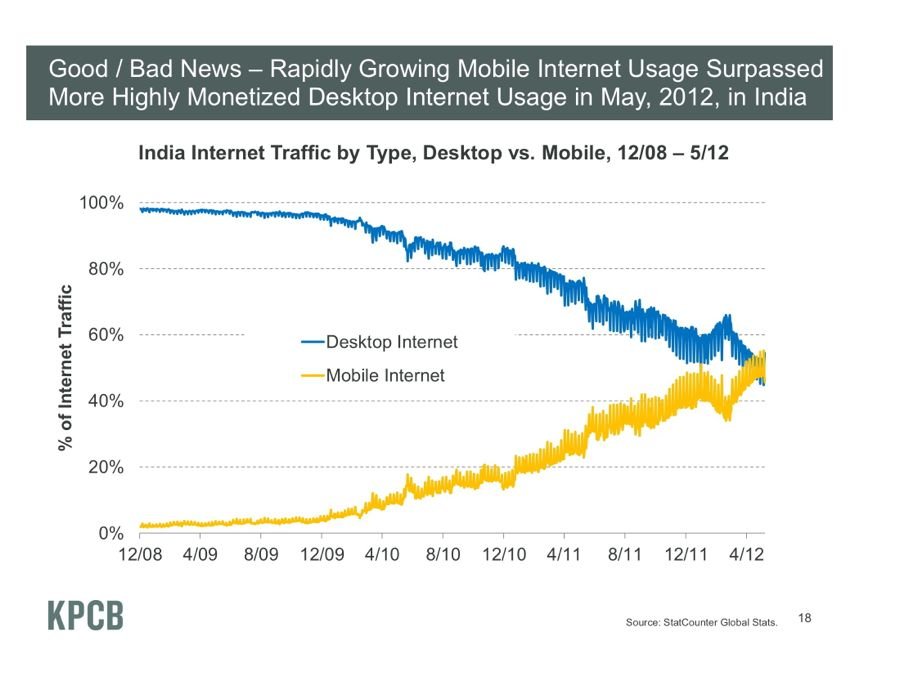
This week both HP and Dell reported significantly weak PC sales. While Meg Whitman asserted that the PC was not dead, the most alive aspect in the market featured smartphones and tablets.  A quick perusal of the landscape reveals even more signs of mobility moving from a trend to a certainty.  Yesterday PayPal and Discover announced a partnership that ups the ante on the Starbucks and Square news earlier this month and adds to the momentum building for mobile payments. Three months ago, Mary Meeker presented her analysis of the Internet at the D: All Things Digital conference ion California. While her presentation in its entirety is well worth the strong impact it continues to make, one particular slide really hit home (see below). For years people have talked about working from home versus working from the office. But the mobility tsunami is so much more than that.  We are rapidly approaching the point where we can choose to work, learn, play connect or do from where we want to be, not where we have to be. And as we become increasingly untethered, a chosen place will need to be much more than its simple physicality to be highly valued by its occupants.

update: One more note of mobility challenging previous practice – Facebook and ads

Goodbye to being tethered?

Sourcing patterns

Earlier this week, the Internet was quivering with a “discovered” news story about Apple’s new proprietary screw that would make it difficult for anyone without a special tool to pry open the case of a product. So what’s the problem?  The story didn’t have even a shred of truth. A company in Sweden merely posted an image as bait and watched with amusement as the reporters, pundits and fans created a writhing mass of information sharing.

The rush to be first to report isn’t unique to the Internet. Neither is error created through failure to adequately and correctly confirm through sources. Recall the famous Woodward and Bernstein gaffe about Haldeman and GOP re-election funds. Both examples however, also illustrate the fascinating pattern-matching abilities we have. The account of being duped by the purported Apple screw image in ReadWrite Web shows how easily we filter information based on the assumptions that we already have. That is what the Internet makes so incredibly simple for everyone – surrounding us with so much that our pattern-matching remains on high alert for those aha! moments when what we think we know is confirmed.

Teaching students the difference between peer-reviewed and popular information simply isn’t enough. While many tout the value of information literacy, and it is a path to apprehending this world, much of the focus is on examining the characteristics of the information as a way to determine its authority. But perhaps just as important is focusing on cognitive self awareness and the patterned assumptions that instantly make some bit of information appear a bit brighter, a bit more interesting in the turbulent sea of data in which we swim.